How to get web design clients and keep them for years

What’s in this article
- Key takeaways
- Why does finding clients feel like starting from zero every time?
- How do you get web design clients?
- What does a 30-day plan for getting web design clients look like?
- Why does project delivery decide whether clients come back?
- How do you keep web design clients after launch?
- Which part of your growth loop should you fix first?
- FAQ
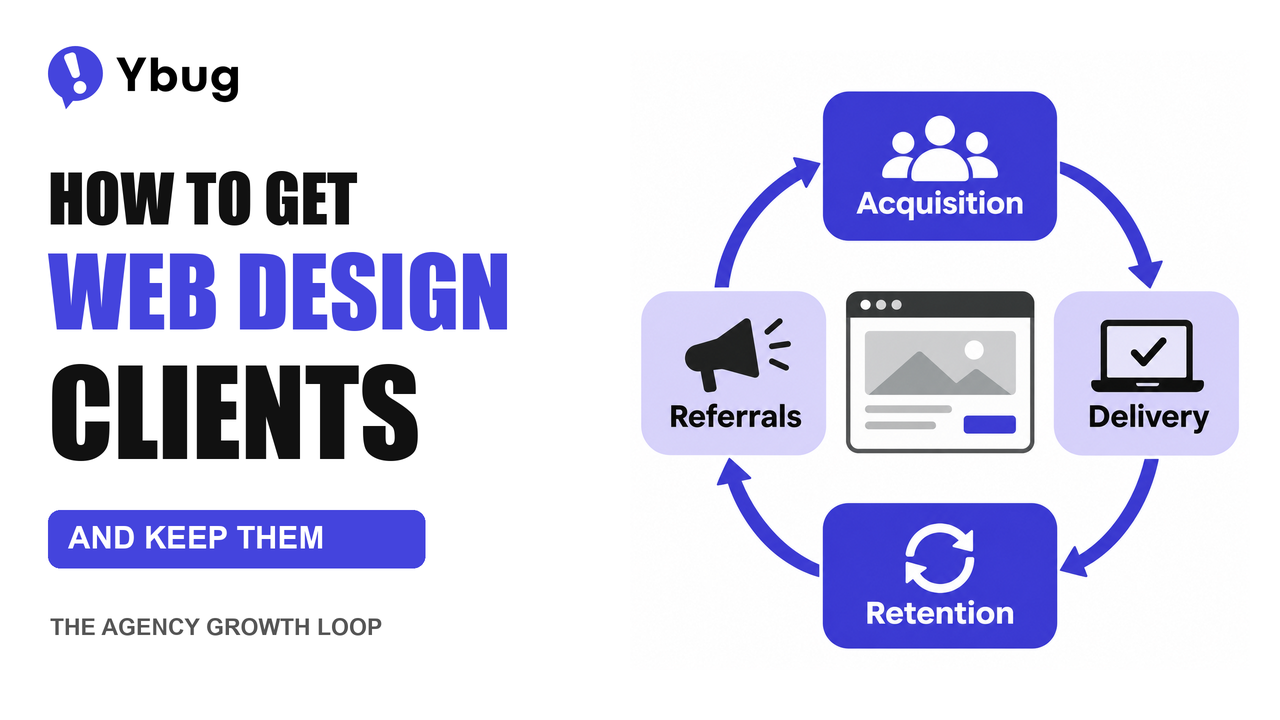
The agency growth loop is the cycle of winning web design clients, delivering their projects smoothly, and turning them into repeat work and referrals, and its main advantage is that every finished project makes the next client easier to win.
Key takeaways
- How to get web design clients: combine 4 channels (referrals, SEO and content, networking, and cold outreach) instead of betting everything on one.
- Referrals are earned during delivery, not after it. A well-run project is your strongest sales asset.
- Cold outreach works when it’s specific: small batches, a real reason to write, and a useful observation about the prospect’s site.
- Delivery is where clients are won or lost for good. One feedback channel, clear revision rounds, and visual context keep projects on track.
- Keeping a client is usually cheaper than finding a new one, so post-launch check-ins and care plans pay off.
Most advice on how to get web design clients stops at the signed contract. That’s why so many studios live in a feast-or-famine cycle: a busy quarter, then an empty pipeline, then a scramble for leads.
The fix isn’t just more prospecting. It’s treating acquisition, delivery, and retention as one loop where each phase feeds the next.
Why does finding clients feel like starting from zero every time?
Because most agencies run sales and delivery as separate jobs. Sales brings a client in, the team ships the site, and nobody owns what happens after launch, so the next client has to come from scratch.
Here’s how the three phases connect:
| Phase | Goal | Main levers | What breaks the loop |
|---|---|---|---|
| Acquisition | Start conversations with the right clients | Referrals, SEO and content, networking, cold outreach | No niche, no visible proof of past work |
| Delivery | Ship the project without friction | Kickoff brief, feedback process, QA, sign-off | Scattered feedback, endless revisions |
| Retention | Turn one project into long-term work | Check-ins, care plans, referral asks | Going silent after launch |
Developers feel the delivery friction, project managers feel the approval delays, and freelancers feel all three at once, because they handle sales, delivery, and support alone.
How do you get web design clients?
You get web design clients through four main channels: referrals, inbound (SEO and content), networking, and cold outreach. Running at least two of them at the same time means one slow channel won’t empty your pipeline. The same playbook covers how to get clients for web development.
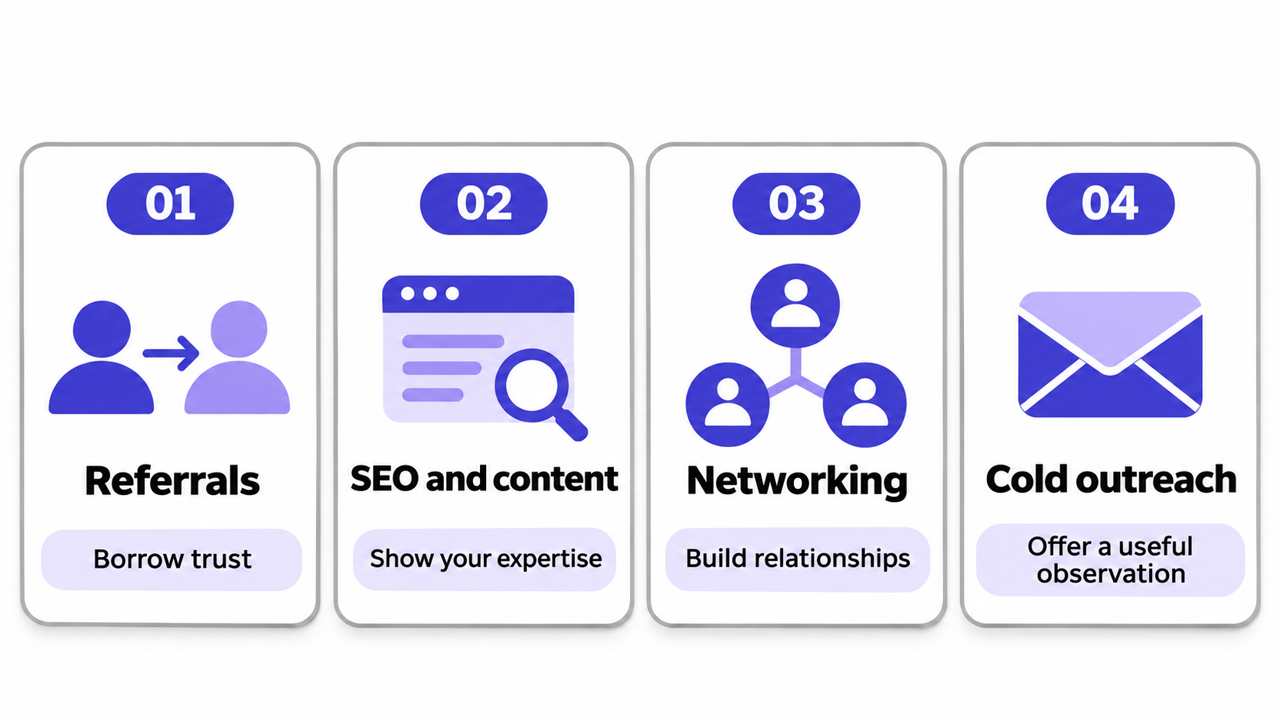
| Channel | Speed to first lead | Main cost | Best for | What to track |
|---|---|---|---|---|
| Referrals | Fast, once you have past clients | Low, mostly relationship time | Studios and freelancers with a track record | Referrals received and won projects per client or partner |
| SEO and content | Usually slower, builds over months | Time and consistency | Agencies with a clear niche | Qualified inquiries from organic search, not just traffic |
| Networking and communities | Medium | Time and presence | Local and niche-focused studios | Qualified contacts and follow-up meetings per event or community |
| Cold outreach | Fast to start, slow to master | Research, copy, tooling | Agencies that need a predictable pipeline | Replies, booked calls, qualified opportunities, won projects |
Also track the time and cost per won project. Plenty of replies with no profitable work isn’t success.
How do referrals bring in web design clients?
Referrals work because they borrow trust. A peer’s recommendation skips the part where the prospect wonders whether you’ll deliver.
If you’re just starting out, begin with people you know who run businesses. Freelancers in developer communities tell the same story: a few early projects done really well led to the next ones.
The catch is that referrals rarely happen on their own. Ask directly, and make it easy with a short message the client can forward:
“Hi Sarah, glad the new site is live! If you know anyone planning a website project this year, I’d love an intro. Here’s a short line you can pass on: we design and build fast, easy-to-edit websites for B2B service companies.”
Don’t forget agency referrals from partners. Copywriters, brand designers, and SEO consultants all meet clients who need a website. A simple “we send each other work” agreement keeps those relationships active.
Can SEO and content help you find web design clients?
Yes, though it usually takes longer than the other channels, and it works best with a clear niche and visible proof. Publish case studies, short write-ups of tricky builds, and pages for the industries you serve. Google’s own SEO Starter Guide is a solid baseline for getting the technical basics right.
If you’re figuring out how to get local web design clients, lead with case studies from your area and a complete local business profile.
A case study that actually helps a prospect decide follows five steps:
-
The problem. What the client needed to solve, and why.
-
The starting point. How the site performed before, with real numbers if you have them.
-
The solution. What you changed and why.
-
The result. What improved, measured over a stated period.
-
The lesson. What a similar client can take from it.
Only publish results you actually measured. Without sales data, show what you can prove, such as better Core Web Vitals or a clean migration.
Where to find web design clients through networking?
Go where your clients spend time, not where other designers hang out: local business groups, industry associations, and niche communities.
The rule practitioners repeat most is help first, pitch later. Answer questions and share quick fixes. Also talk to other agencies, since studios with more work than capacity often subcontract design or development.
Does cold outreach still work for web design leads?
It does, when it’s specific. Generic “I can redesign your website” emails get ignored. Outreach that works points to something real you noticed, like a broken mobile menu or a form that doesn’t submit. A short video walkthrough or a mini audit gives the prospect a reason to reply, but only if it’s genuinely personal. An automated message with one fake “personalized” line about their site does more harm than silence.
For example:
“Hi Tom, I was checking your booking page on my phone and the date picker doesn’t open on iPhone, so some visitors may not be able to book. I recorded a 2-minute video showing what happens. Want me to send it over? Happy to share a quick fix either way.”
A few rules keep web design lead generation sustainable:
-
Start with small batches. A few dozen well-researched prospects make a good first experiment. Measure replies and booked calls before you scale.
-
Follow up, but not forever. Two or three polite follow-ups are a sensible default. Adjust based on the replies you get.
-
Stay compliant. In the US, the CAN-SPAM Act also covers business-to-business email. It requires honest sender details and subject lines, your physical address, and a working opt-out you honor promptly. These rules are US-specific, so if you contact prospects in other countries, check local rules on unsolicited commercial email and data protection (such as GDPR in the EU) first.
Running outreach well takes copywriting, domain warm-up, and reply handling, so if you’d rather hand it to specialists, see our roundup of the best cold email outreach agencies for web and development agencies.
What does a 30-day plan for getting web design clients look like?
Not sure where to start? Run one simple cycle and measure it:
| Week | Focus | What to do |
|---|---|---|
| Week 1 | Pick your target client | Choose one client type, such as B2B SaaS companies, local service businesses, or small online stores. Write down the problems you solve for them. |
| Week 2 | Prepare proof | Write one case study, refresh your portfolio, and ask past clients and partners for introductions. |
| Week 3 | Run a small experiment | Send individually written messages to a short list of relevant companies, and reach out to two or three potential referral partners. |
| Week 4 | Review and adjust | Count replies, booked calls, qualified opportunities, and won projects. Adjust your target client, offer, or message based on what you see. |
Treat it as a starting routine, not a promise of a signed client in 30 days.
Why does project delivery decide whether clients come back?
Because delivery is the only phase the client actually experiences. They see how quickly you replied, how clearly you handled their feedback, and whether launch day felt calm or chaotic. That experience weighs heavily on whether they hire you again or recommend you. Price, results, and changing budgets matter too, but delivery is the part you fully control.
Most delivery friction comes from feedback, not code. Agency and freelancer discussions repeat the same complaints:
-
Scattered feedback. Comments arrive by email, chat, phone calls, and blurry phone photos.
-
Vague requests. “Make it pop” or “the button looks off”, with no page, no browser, and no screenshot.
-
Drip-fed changes. Notes trickle in one by one, so every round takes twice as long.
-
Unclear revision limits. Small tweaks pile up until the project quietly turns into a redesign.
How should agencies collect client feedback during a project?
Set the rules at kickoff and give clients one place to leave feedback. A good web design client questionnaire captures goals and expectations before design starts. Then write the number of revision rounds, what counts as a change request, and expected turnaround times into the contract.
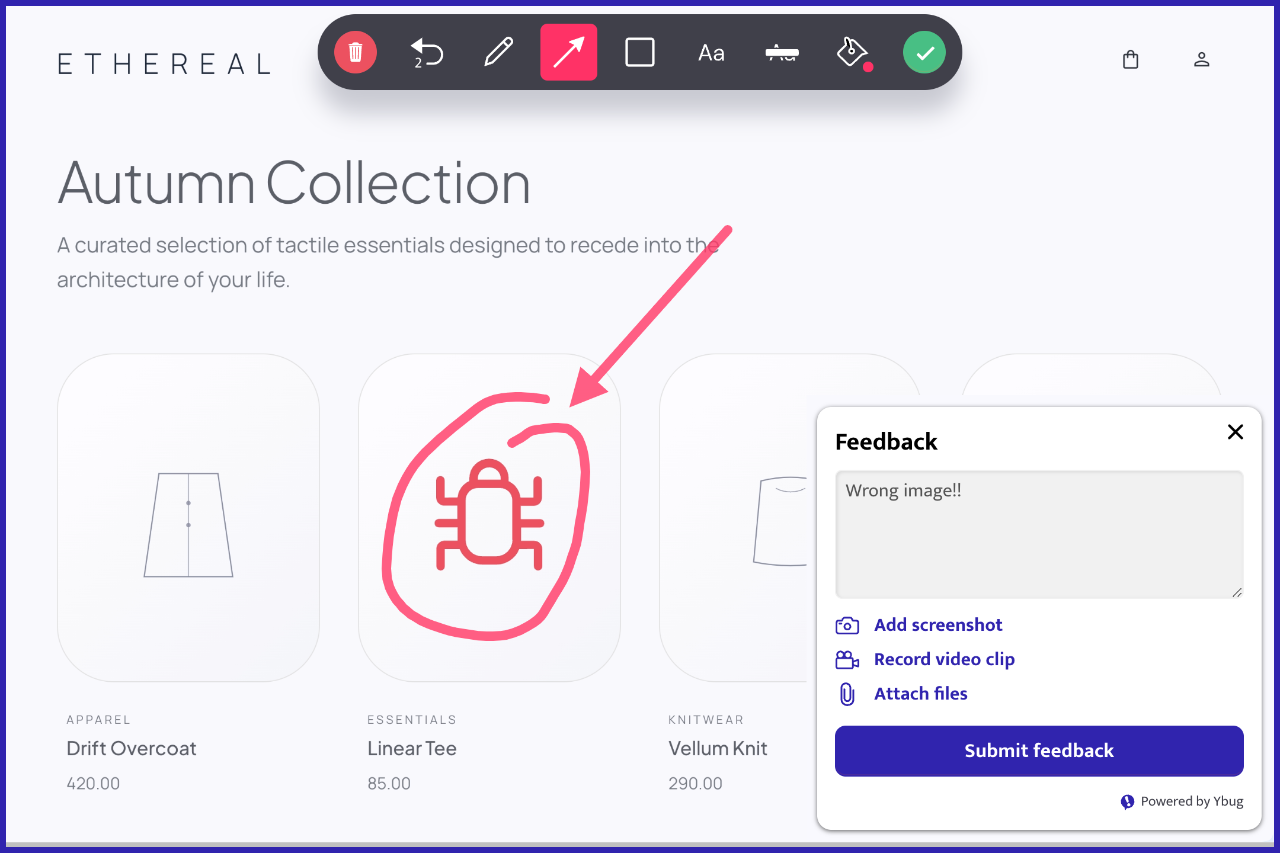
Define where feedback fits in each stage of your web design workflow, so clients know when their input is needed.
During the build, the biggest win is visual context. When a client can click the exact element, mark it up on a screenshot, and submit, you get the page URL, browser, and screen size without asking. That’s the job of a visual feedback tool like Ybug, and it removes most of the back-and-forth that slows approvals.
Compare client feedback tools on three things: ease of use for non-technical clients, technical details for developers, and a connection to the tracker your team already uses.
What does a smooth feedback round look like?
Here’s a workflow that keeps a client review round short:
-
The project manager shares the staging link and a clear deadline for round two.
-
The client clicks through the site and leaves annotated comments directly on the pages.
-
Each comment lands in the team’s task tracker with the URL, browser, and screenshot attached.
-
Developers fix the issues and mark them resolved, so the client sees progress without chasing anyone.
-
Before go-live, QA works through the website launch checklist and the client signs off.
Agencies put a lot of energy into finding the next client and much less into making the current project feel easy. But the client who never had to chase you for an update is the one who recommends you without being asked.
How do you keep web design clients after launch?
You keep clients by staying useful after the site goes live. Launch is where many agencies disappear.
Retention also makes financial sense. Keeping clients is usually much cheaper than winning new ones, because you skip prospecting, pitching, and onboarding. Harvard Business Review cites estimates of five to 25 times the cost for acquisition, depending on the study and industry.
What does good agency client retention look like?
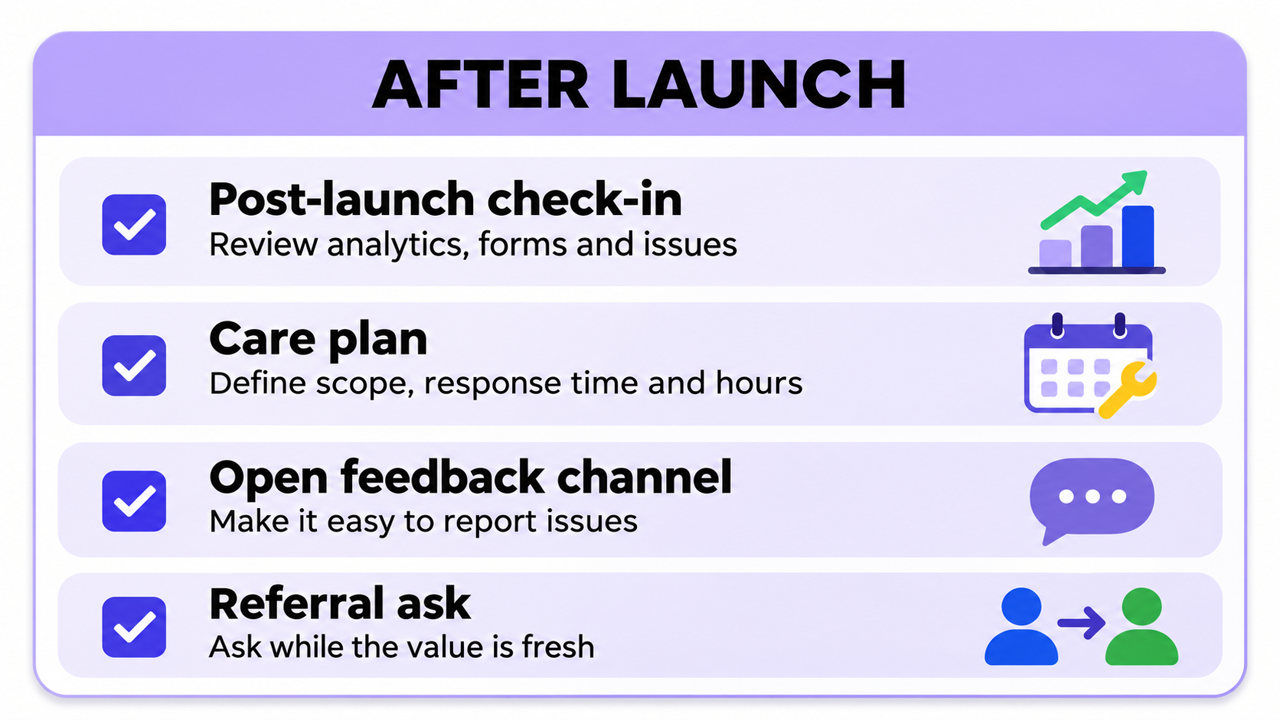
Of all client retention strategies, three habits matter most for agencies:
-
A post-launch check-in. Review analytics, form submissions, and issues after the first few weeks.
-
Ongoing care plans. CMS and plugin updates, backups, uptime and error monitoring, security checks, small development tweaks, and a monthly analytics review turn a one-off project into recurring revenue.
-
A feedback channel that stays open. If clients can report issues on the live site, small requests come to you, not the next agency.
Give every care plan a clear scope, response time, and monthly hour cap. Without them, a retainer turns into unlimited work instead of predictable income.
Strong agency client retention helps every role: predictable workloads for project managers, a familiar codebase for developers, and a steady monthly baseline for freelancers.
When should you ask a happy client for a referral?
Ask when the value is fresh: right after launch, after a strong first month, or when the client thanks you for a quick fix. Pair it with a testimonial request.
That’s where the loop closes: a smooth project creates a happy client, and a referral is the easiest new client you’ll ever win.
Which part of your growth loop should you fix first?
Fix the phase where your problems actually start. Use the symptoms to find it:
| Symptom | Where it starts | First fix |
|---|---|---|
| Too few conversations with prospects | Acquisition | Pick one niche and one outbound channel, and run it every week |
| Leads come in but rarely sign | Acquisition (proof) | Add case studies and clear pricing ranges to your site |
| Projects drag past deadlines | Delivery | Centralize feedback and limit revision rounds |
| Clients leave after launch | Retention | Offer a care plan in the proposal, not after launch |
| Many happy clients, few referrals | Retention | Ask directly and give clients a line they can forward |
For most studios, delivery is the cheapest phase to fix, and a calmer project lifts the other two phases with it.
Give clients one place to leave visual feedback on your website projects.
(no credit card needed)


