Collecting guest feedback in hotels and travel brands

What’s in this article
- Key takeaways
- Why does feedback timing matter more than format in hospitality?
- What are the stages of the guest feedback lifecycle?
- What tools for customer feedback work best in hospitality?
- How do you act on feedback in real time?
- How do you connect feedback to your existing systems?
- How do you use feedback to improve, not just react?
- FAQ
Guest feedback is the information guests share about their stay at every stage of the journey, and its main advantage is that it lets hotels fix problems while a guest is still there to benefit from the fix.
Key takeaways
- Collect feedback during the stay, not only after checkout, so issues can still be resolved before the guest leaves.
- Use different tools for each stage of the guest journey: pre-stay, in-stay, and post-stay.
- Connect feedback to your PMS and operational systems to automate workflows and add context.
- Monitor your booking website alongside guest experience feedback, since booking bugs cost revenue before a guest ever arrives.
- Look for recurring patterns across feedback, not just individual complaints, to drive long-term improvements.
Why does feedback timing matter more than format in hospitality?
Most customer feedback collection tools are built around a single moment: post-purchase, post-interaction, post-resolution. Hospitality is different because the stay itself lasts hours or days, during which dozens of small experiences shape the guest’s overall impression.
A post-stay survey captures an aggregate impression, often softened or sharpened by whatever happened most recently: a smooth checkout can offset a rough first night, and a late arrival can color an otherwise great stay. It tells you how the guest felt overall, but rarely gives you the specific, actionable detail of what happened, where, and when, which is what operations teams actually need to fix something.
In-stay feedback, collected while the guest is still present, closes this gap. It captures issues with enough immediacy and specificity that staff can resolve them before the guest leaves, turning a potential negative review into a recovered experience.
This matters more than it might seem. For every guest who actually complains, an estimated 26 more stay quiet and simply never come back. Post-stay surveys only catch the guests willing to fill them out. In-stay feedback, especially a low-friction channel like a message or a QR code, catches the ones who would otherwise say nothing, then leave a quiet, permanent dent in your repeat bookings.
What are the stages of the guest feedback lifecycle?
Pre-stay feedback happens during booking and pre-arrival communication: special requests, accessibility needs, and expectations set before arrival. Capturing this accurately reduces in-stay friction caused by unmet expectations that were never actually communicated.
In-stay feedback is the highest-value, most underused stage. This is where a guest can flag a maintenance issue, a service gap, or a question, and where a property has the most ability to fix things before checkout. Channels include in-room QR codes linking to a quick feedback form, in-app feedback for properties with a dedicated guest app, and direct staff check-ins, which should be logged, not just remembered.
Most independent hotels do not have a native app, but the same idea works through a web-based guest portal: a QR code on the nightstand opens a welcome page over the guest Wi-Fi, and a feedback widget embedded on that page lets the guest report a room issue in two taps, no app download required. Guests also tend to respond more readily to a short message asking how their stay is going than they do to initiating contact themselves: most people will not walk to the front desk over a minor inconvenience, but they will reply to a text.
Post-stay feedback is the most common and most familiar: review platforms, post-checkout email surveys, NPS. It is useful for tracking trends and reputation, but it is reactive by definition. Whatever went wrong has already happened by the time you hear about it.
A complete guest feedback program uses all three stages, but the biggest gap most properties have is the middle one: in-stay feedback that is structured and timely enough to act on.
What tools for customer feedback work best in hospitality?
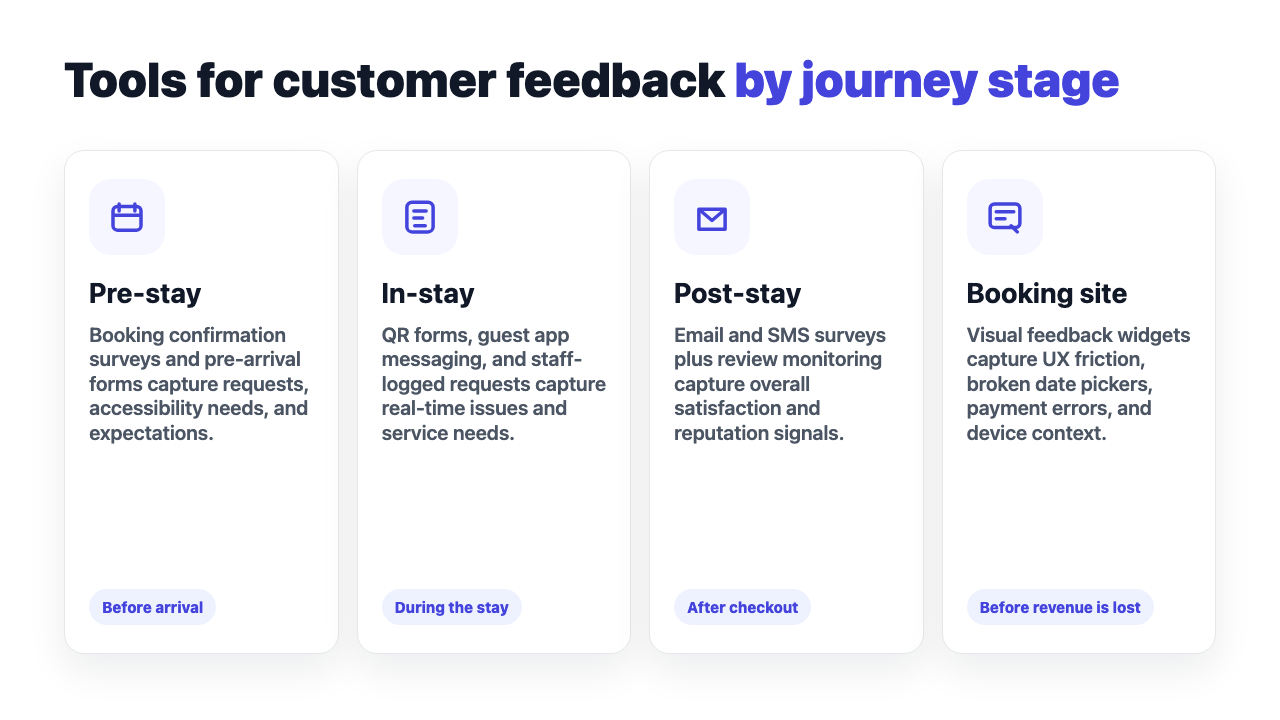
| Stage | Tool type | What it captures |
|---|---|---|
| Pre-stay | Booking confirmation surveys, pre-arrival forms | Special requests, expectations, accessibility needs |
| In-stay | QR code feedback forms, guest app messaging, staff-logged requests | Real-time issues, service requests, immediate concerns |
| Post-stay | Email/SMS surveys, review platform monitoring | Overall satisfaction, public reputation, NPS trends |
| Website/booking platform | Visual feedback widget | Booking flow issues, broken functionality, UX friction on your site |
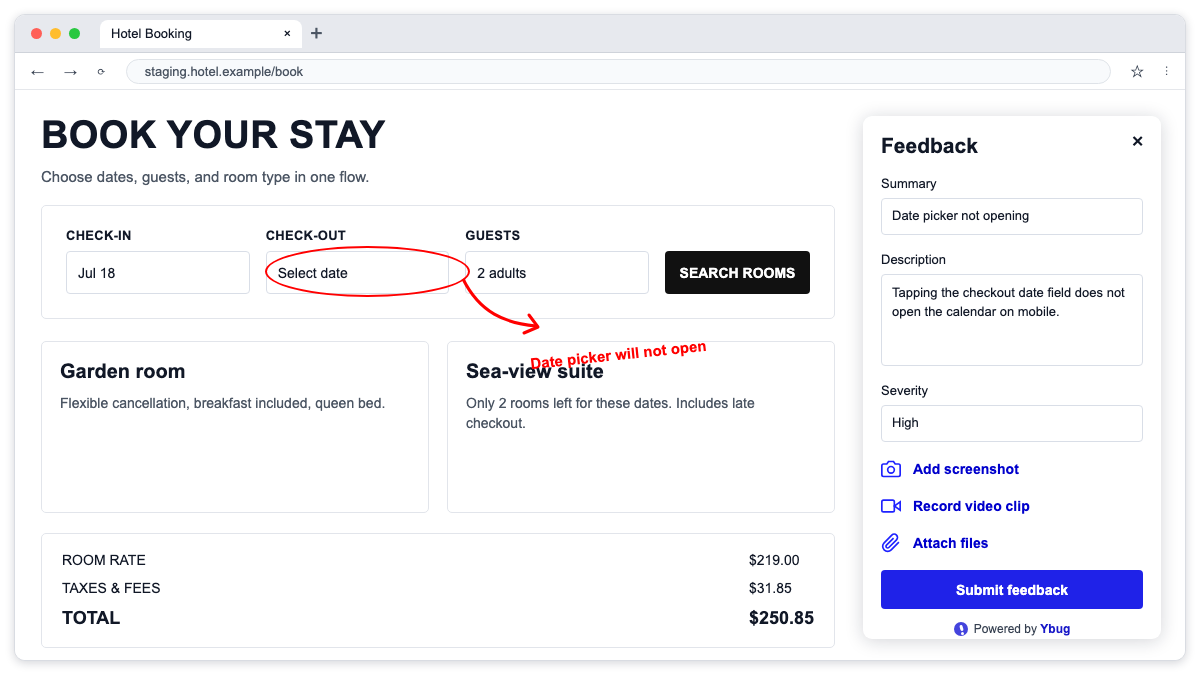
A category often missed in hospitality feedback planning: feedback about the booking website itself, not just the physical stay. If your booking flow has a bug, like a date picker that does not work on mobile or a payment step that fails, that is lost revenue before a guest ever arrives. Hotel booking abandonment already runs high under normal conditions. Industry data puts the average cart abandonment rate for hotels at around 80%, and a broken step in the flow only adds to that.
Choosing the right software for customer feedback depends on when you want to collect insights. Hospitality businesses typically need different tools for pre-stay, in-stay, and post-stay interactions rather than relying on a single feedback solution. The same general principles that apply to how to collect user feedback on any website apply here too: make it easy, make it specific to the moment, and make sure it reaches someone who can act on it.
A visual feedback tool installed on your booking site captures these issues with an annotated screenshot and automatic technical context like browser, device, URL, and console data. It gives web teams the same kind of real-time signal that in-stay feedback gives hotel operations teams.
Hospitality teams often get very good at training staff to spot problems during a stay, while treating the booking website as someone else’s problem. In practice, a broken date picker costs a booking just as surely as an unresolved maintenance issue costs a repeat guest.
Hospitality teams are excellent at training staff to notice problems during a stay. The same urgency rarely extends to the booking website, but a broken date selector or a checkout error on your site is just as damaging to revenue and guest trust as a maintenance issue in a room.
That is where website feedback needs a shorter path from frustrated guest to the team that can fix the flow.
Ybug helps hospitality and travel teams catch booking site bugs with annotated screenshots and technical context included automatically.
(no credit card needed)
How do you act on feedback in real time?
Effective customer service feedback software helps hospitality teams assign issues, monitor response times, and ensure every guest concern reaches the right person quickly. Collecting in-stay feedback only matters if there is a clear path from “guest reported an issue” to “staff resolved it before checkout.” This requires:
- A defined response owner. Someone, front desk, guest services, or duty manager, needs explicit responsibility for monitoring incoming in-stay feedback and triggering action within a short, defined window. Many properties aim for under 30 minutes on in-room issues.
- Escalation paths for different issue types. A maintenance request routes differently than a billing question or a service complaint. Map these paths in advance so feedback does not sit waiting for the “right” person to notice it.
- A way to close the loop with the guest. When an issue is resolved, let the guest know directly. A quick note or in-person follow-up that the air conditioning has been fixed turns a complaint into a recovered, even strengthened, impression.
- Tracking, even for resolved issues. A maintenance issue resolved quickly for one guest might be the third report of the same problem this month. Without tracking, recurring issues stay invisible until a guest finally posts a public review about it.
That third point connects to something researchers call the service recovery paradox: a guest whose problem gets fixed quickly and well can end up more satisfied than a guest whose stay had no issues at all. The effect is strongest for smaller failures resolved fast, and it is not a reason to stop aiming for a smooth stay in the first place. But it is a good reason to want the complaint. A guest who never mentions the noisy air conditioning gives you no chance to turn the moment around, which is exactly why capturing feedback in real time matters more than trying to prevent every possible complaint.
How do you connect feedback to your existing systems?
Modern software for customer feedback becomes significantly more valuable when it is connected to your PMS, CRM, and support systems. Hospitality operations already run on a Property Management System (PMS) and often a separate Point of Sale (POS) system. Established guest feedback platforms already build directly into major PMS software like Mews, pushing satisfaction scores and complaint flags straight into the guest profile so front desk staff and management see them at a glance.
Feedback tools that integrate this way unlock automation that standalone survey tools cannot:
- Trigger surveys automatically on checkout, tied to the actual stay record in your PMS. No manual list-building required.
- Tie feedback to specific stay details, such as room number, dates, and rate plan, so a complaint about “the room” comes with the actual room number attached, not a guest’s vague memory of it.
- Link feedback to revenue and operational data. A service complaint that correlates with a specific shift, room type, or season is a pattern worth investigating, visible only if the data connects.
For the booking website specifically, hospitality and travel brands benefit from connecting their feedback widget to the same project management or support tool the web team already uses via integrations, so a booking flow bug reported by a guest or internal tester reaches the development team as a structured ticket, not a forwarded email. Before launching a new booking flow or seasonal promotion page, our website launch checklist covers the broader pre-launch verification that applies to any booking or e-commerce-style site.
How do you use feedback to improve, not just react?
Beyond fixing individual issues, the real value of a structured guest feedback program is the pattern data it generates over time.
Review feedback by category monthly, not just by individual incident. If “slow check-in” appears repeatedly across different guests and shifts, that is an operational process issue, not a one-off staffing problem.
Cross-reference in-stay and post-stay feedback. If in-stay issues are being resolved well but post-stay scores still lag, the resolution itself may not be satisfying guests, which is worth investigating directly.
Treat your booking website feedback with the same rigor as guest experience feedback. A pattern of booking flow complaints, confusing date selection, unclear cancellation policy, or slow page load is costing bookings just as surely as a pattern of in-room service complaints costs repeat stays.
Share feedback trends with the whole team, not just management. Front-line staff who see how their service shows up in feedback data tend to engage more actively with improving it than staff who only hear about problems secondhand.
Use Ybug to collect clear booking-site feedback before small website issues turn into abandoned reservations.
(no credit card needed)