How to respond to customer reviews in real estate

What’s in this article
- Key takeaways
- Why does responding to reviews matter for real estate agents?
- How to respond to positive reviews
- How to respond to negative reviews
- How quickly should you reply to customer reviews?
- How do you get more real estate reviews without breaking the rules?
- How do you track and manage reviews across multiple platforms?
- FAQ
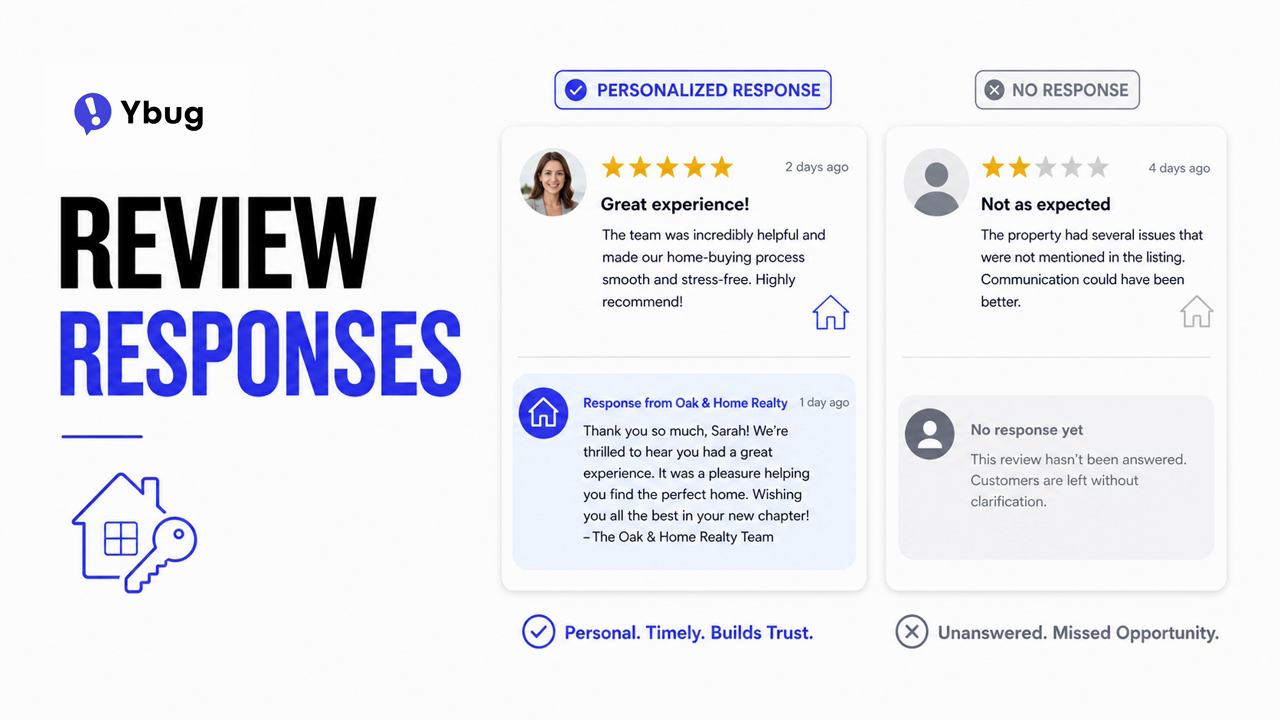
Responding to customer reviews is the practice of publicly replying to feedback that clients leave on platforms like Google, Zillow, and Facebook, and its main advantage is that the reply shapes how every future prospect judges your reputation, not just the person who wrote it.
Key takeaways
- Respond to every review, positive or negative, ideally within 24 to 48 hours.
- Personalize each reply with a specific detail instead of a generic template.
- Handle negative reviews calmly, then move detailed conversations offline.
- Ask every client for a review, not only the ones you expect to be happiest. Selectively soliciting reviews, known as review gating, is prohibited under FTC rules.
- Track reviews across every platform you use so nothing goes unanswered for weeks.
Why does responding to reviews matter for real estate agents?
Reviews are public, and so are your responses. Every reply you write gets read not just by the original reviewer, but by every future prospect who looks up your reviews before deciding whether to call you.
For many real estate professionals, Google Reviews are the first impression a prospective client sees. Consistently responding to reviews on Google demonstrates professionalism, improves trust, and signals that you actively engage with client feedback.
For positive reviews, a thoughtful response shows you value the relationship beyond the closing, which matters enormously in real estate, where referrals and repeat business depend on long-term trust rather than a single transaction.
For negative reviews, your response is often more visible and more scrutinized than the complaint itself. A defensive or dismissive reply confirms the worst version of the story. A calm, specific, solution-oriented reply can neutralize the negative impression almost entirely, and sometimes prospects trust an agent more after seeing how they handled criticism well.
For search visibility, review platforms also look for signs that a business is active and engaged. Businesses that respond consistently tend to look more credible than those that leave public feedback unanswered.
How to respond to positive reviews
The biggest mistake with positive reviews is treating them as if they do not need a response. They do. A quick, specific reply takes thirty seconds and reinforces the relationship.
What makes a good response to a positive review:
- Thank the reviewer by name.
- Reference something specific from their review, not a generic “thanks!”
- Reinforce your value proposition briefly.
- Invite continued engagement, such as referrals or future business.
Example: buyer agent
“Thank you so much, Sarah! It was a pleasure helping you find your first home. Your patience through the offer process really paid off. If any friends or family are starting their own home search, I would love to help them too. Congratulations again on the new place!”
Example: listing agent
“Thank you for the kind words, James! Getting your home sold above asking in under two weeks was a great outcome for both of us. I appreciate you trusting me with such an important sale, and I am always here if you need anything in the future.”
Example: property management
“Thanks for taking the time to share this, Maria. We are glad the maintenance response time worked well for you; that is something our team prioritizes. Welcome to the building, and do not hesitate to reach out if anything comes up!”
How to respond to negative reviews
Negative reviews require more care, but the structure stays consistent: acknowledge, clarify briefly if needed, offer to resolve offline, and stay professional throughout.
What makes a good response to a negative review:
- Respond promptly, but not defensively.
- Acknowledge the specific concern raised.
- Avoid arguing publicly, and offer to discuss details privately.
- Never disclose private client information in a public response, even to defend yourself.
- Close with a clear next step.
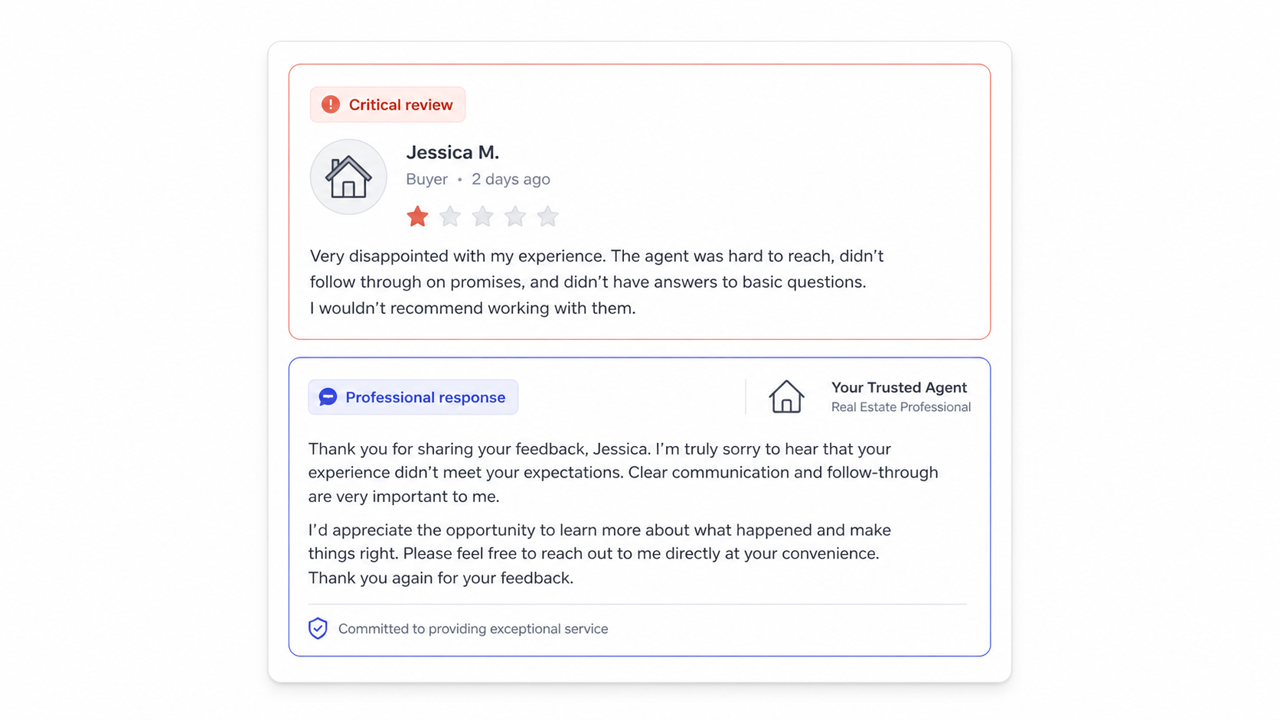
Example: disputed communication
“I am sorry to hear the closing process felt stressful, and I appreciate you sharing this feedback. Communication during a transaction is something I take seriously, and I would like to understand what happened from your perspective. Please reach out to me directly at [contact]. I would welcome the chance to address this.”
Example: pricing or fee complaint
“Thank you for sharing your experience. I want to make sure any questions about commission and fees are fully addressed. These are outlined upfront in our agreement, but I understand they can feel confusing during a stressful transaction. I would be glad to walk through this with you directly if you would like to call or email me.”
Example: factually incorrect or mistaken-identity review
“I want to make sure we have an accurate record of what happened here. I do not have a record of working with you on this transaction. Could you reach out directly so we can clarify? We take every client relationship seriously and want to resolve any confusion.”
Fake and mistaken-identity reviews come up often enough in real estate that it is worth planning for. A review can come from a competitor, a disgruntled buyer who lost a bidding war, or simply someone who mixed up two agents with similar names. Removing a review, even one you can prove is false, is difficult. Google and Zillow generally only remove content that violates their own guidelines, not content you simply disagree with. On Zillow specifically, agents can respond publicly and can flag a review for re-moderation if it looks fake, off-topic, or abusive.
When you respond to a suspected fake review, write for the moderator, not just for the reviewer. A calm, factual line such as “we do not have any record of a client or property matching this description in our files” gives the platform review team something concrete to check, which is more useful for a flagged review than simply asserting that the reviewer is lying.
Never disclosing private client details in a public reply is not just good etiquette; it is an ethical obligation. Realtors are bound by the NAR Code of Ethics, including Article 1, Standard of Practice 1-9, which requires preserving confidential information shared by a client during the relationship unless the client agrees otherwise or disclosure is required by law.
What to avoid: never get into a back-and-forth public argument in the comments. One measured response is enough. Additional replies tend to make the situation look worse, not better, to anyone reading later.
The response to a negative review is often more important than the review itself, because it is the part most people actually read carefully. A calm, specific, professional reply does more to protect your reputation than trying to get the review taken down.
That same principle applies before frustration becomes public. If a client has a problem in your website, portal, or intake flow, give them a private way to report it before the issue turns into a review.
Ybug helps teams catch website and portal feedback early, with annotated screenshots and technical context included automatically.
(no credit card needed)
How quickly should you reply to customer reviews?
When you commit to reply to customer reviews quickly and consistently, timing matters almost as much as tone. Respond within 24 to 48 hours when possible. Quick responses signal that you are actively engaged with your reputation, and they limit how long a negative review sits unanswered and visible. Every public reply becomes part of your reputation and shapes how future clients see you.
Match tone to platform. Google and Yelp responses are typically more formal and concise. Facebook responses can be slightly warmer and more conversational, matching the platform tone.
Never reuse a template word for word across reviews. A response that is obviously copy-pasted, especially for negative reviews, reads as dismissive. Use templates as a starting structure, but personalize at least one or two sentences to the specific review every time.
How do you get more real estate reviews without breaking the rules?
The best response strategy does not matter much if you are not generating enough reviews in the first place. For real estate professionals specifically, the first rule is simple: ask every client, not just the happy ones.
It is tempting to send review requests only to clients you are confident will leave five stars, but selectively soliciting or filtering reviews based on expected sentiment is called review gating. The FTC’s Consumer Reviews and Testimonials Rule has prohibited review practices that misrepresent consumer feedback since October 2024, and violations can lead to civil penalties. Google’s contributed content policy separately prohibits discouraging or selectively soliciting reviews.
The safest approach is to ask every client the same way, regardless of the outcome.
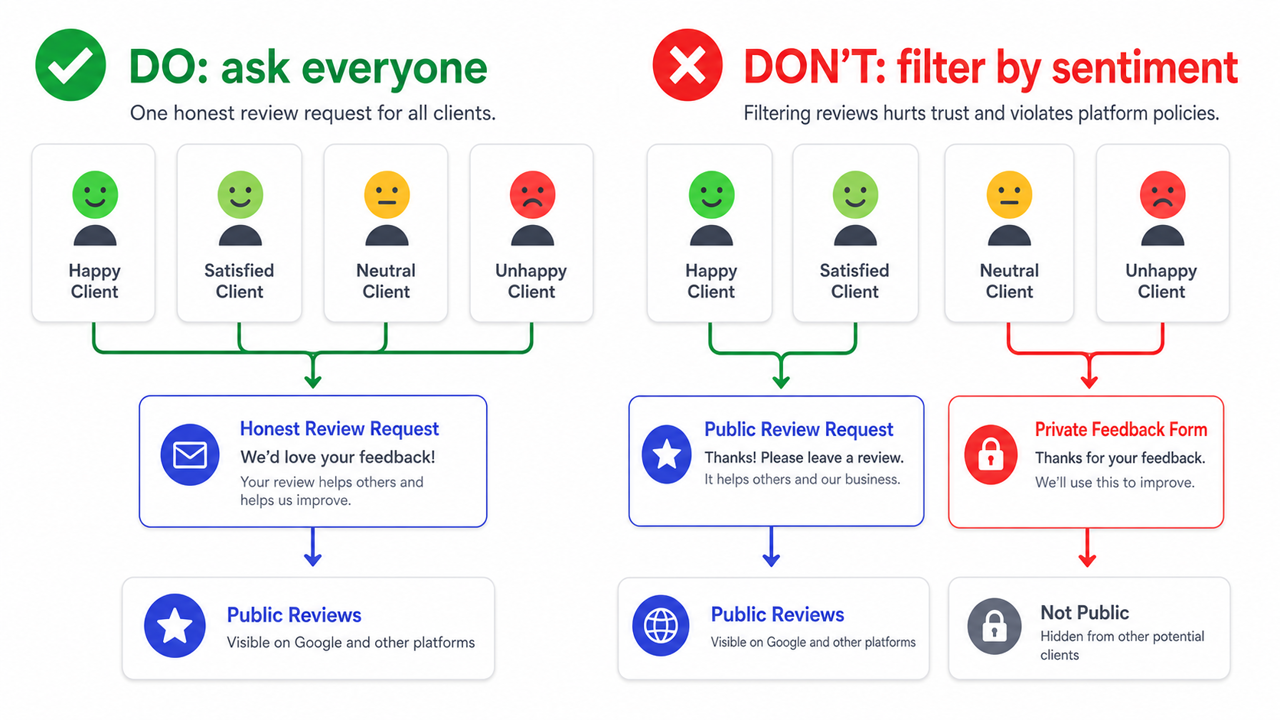
The line is simpler than it sounds:
- Prohibited review gating: emailing clients “Were you happy with our service? Yes / No,” then routing “Yes” to your Google review link and “No” to a private complaint form.
- Safer review request: emailing every client the same message, such as “Thanks for working with us. We would appreciate an honest review on Google, or feel free to tell us directly what we could do better,” with both options open to everyone.
Ask at the moment of highest satisfaction, typically right after closing, when relief and gratitude are both high. Waiting weeks reduces response rates significantly.
Make the ask specific and easy. Send a direct link to your preferred review platform rather than a general “please review us” message, and reduce every possible step between the ask and the submitted review.
Follow up once, politely, if there is no response. A single gentle reminder a week or two later catches clients who intended to leave a review but got busy.
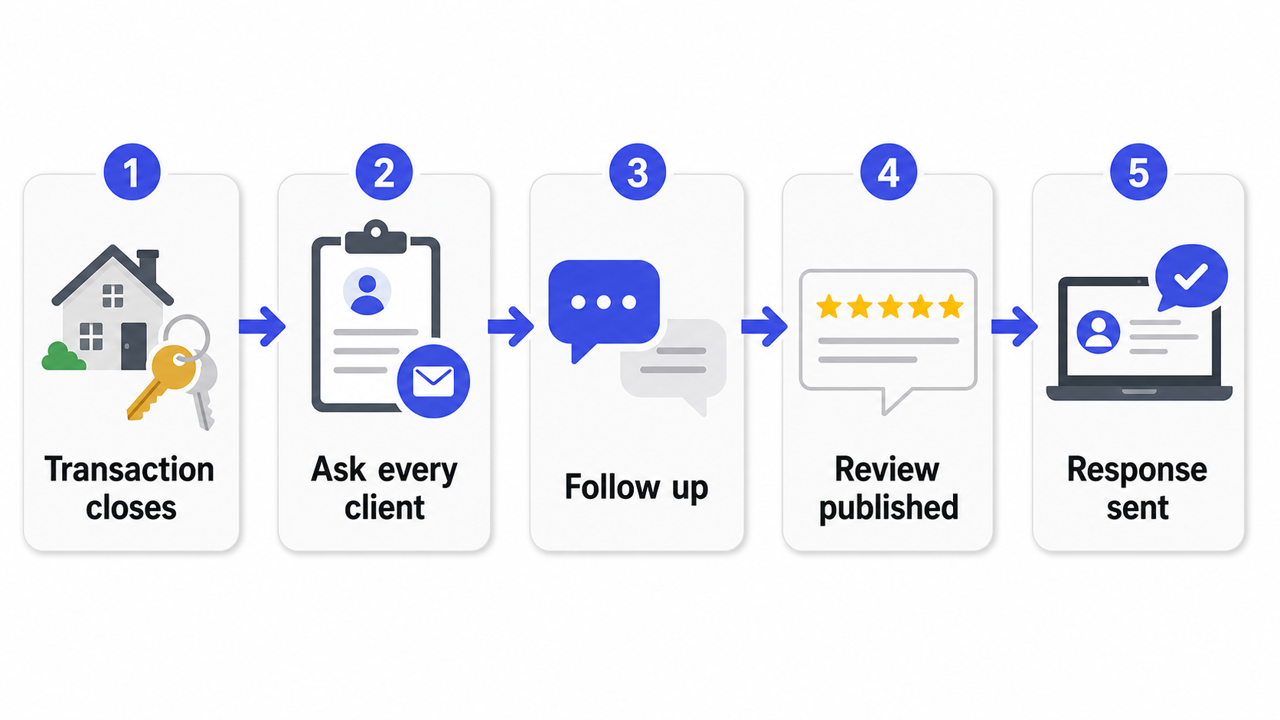
Collect feedback before it becomes a public review. A private feedback channel, such as a quick survey or feedback form sent post-transaction, lets you catch and resolve concerns before they turn into a negative public review. This is the same principle behind how web teams collect user feedback on their own websites: catching dissatisfaction early, in a private channel, prevents it from surfacing publicly later.
This principle matters most for brokerages, developers, and teams running their own client portal or property search site, less so for a solo agent personal site. If a buyer hits a broken document upload or a confusing step while working with your portal, a website feedback tool lets them flag it privately right there, instead of venting on Google later.
Catching client frustration before it becomes a public review starts with giving people an easy way to flag problems in the moment.
(no credit card needed)
How do you track and manage reviews across multiple platforms?
Real estate professionals typically have reviews scattered across Google, Zillow, Realtor.com, Facebook, and Yelp, making it easy to miss one that needs a timely response.
Set up alerts for new reviews on every platform you are active on, so nothing sits unanswered for weeks. On Zillow, for example, agents get an email notification as soon as a review publishes and can respond directly from their profile page.
Keep a simple log of reviews and responses: date, platform, sentiment, response sent. This lets you spot patterns over time. Recurring complaints often point to a process issue worth fixing, not just a one-off bad experience.
For real estate teams and agencies managing review reputation alongside their website, the same discipline applies: responding promptly, tracking patterns, closing the loop. Our guide on how to add a feedback button to your website covers how to set this up in a few minutes.